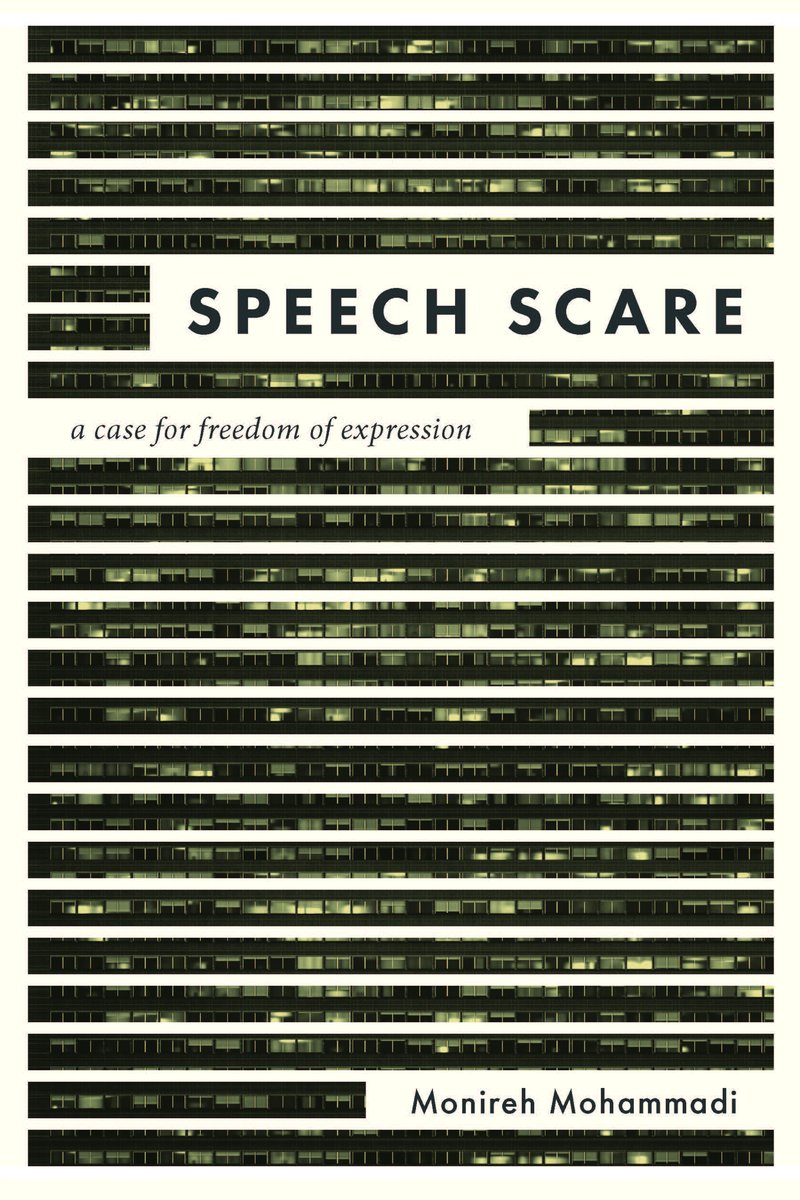
Cover of Speech Scare: A Case for Freedom of Expression by Monireh Mohammadi. The title sits between horizontal strips of lit office windows that look like redaction bars.

SPEECH SCARE

a case for freedom of expression

Monireh Mohammadi

Speech Scare is a groundbreaking defence of free expression, a Charter right that policy makers increasingly neglect as they rush to police speech rather than trust public debate to counter hate.

UBC Press · Forthcoming 2027 · Law, Politics, and Society

Preorder links coming soon About the book

About the book

Freedom of expression in Canada is constitutionally guaranteed and defended in principle. But Speech Scare shows how and why it is increasingly threatened in practice. Tracing Canada’s hate speech laws from their origins in the 1960s to the present, Monireh Mohammadi finds their justifications flawed and their application marked by excessive subjectivity and inconsistency. She shows that Canada’s hate speech legal regime has become a tool for censorship and a breeding ground for hate speech politics. The effect is a social phenomenon Mohammadi calls “speech scare,” which spreads fear of speaking freely and the possible consequences: accusation, prosecution, reputational harm, or institutional sanction.

Canada’s hate speech laws empower well-resourced entities to silence their critics. Speech Scare shows that under this regime structural inequality deepens, as the regime’s silencing effects fall hardest on marginalized groups with the least access to power, depriving them of speech, which is their principal means of resisting oppression.

Speech Scare makes the case that hate speech is best answered through counter-expression, public participation, and education, with legal coercion reserved for direct harassment or incitement to violence. This book offers a principled defence of free expression as a precondition of democracy and equality.

How to cite

Mohammadi, Monireh. Speech Scare: A Case for Freedom of Expression. UBC Press, 2027.

Chicago style, 18th edition. Page numbers and ISBN will be added on publication.

Contents

  1. Introduction
  2. 1Theoretical Framework: Speech Act, Harm, and Limits of Law
  3. 2Origins and Politics of Hate Speech Laws in Canada
  4. 3Through the Looking Glass: Judicial Inconsistency
  5. 4Speech Scare: Concept and Critique
  6. 5Targeting Dissent in the Digital Age
  7. Conclusion

Praise

“This is a very well researched, thoughtful and impressive critique of the nature and negative impact on free expression of anti-hate speech legislation in Canada.”

Anonymous peer reviewer, UBC Press

“In my view, this book is the Canadian supplement to Nadine Strossen’s very important Hate: Why We Should Resist It with Free Speech, Not Censorship …”

Anonymous peer reviewer, UBC Press

“… ground breaking work on this problem which will certainly attract the attention and discussion of both scholars and a larger public …”

Anonymous peer reviewer, UBC Press
Portrait of Monireh Mohammadi

About the author

Monireh Mohammadi is a sociologist of law. She studies hate speech law in Canada and its effects on the constitutionally protected freedoms of expression and peaceful assembly.

She holds a PhD from York University (2023). Her dissertation was titled Free Speech and its Limits: A Study of the Rippling Effects of Hate Speech Laws in Canada. She also holds an MSc in Sociology from the University of Oxford (2015).

She is working on three research projects. The first uses in-depth interviews to examine whether Canadians understand what hate speech law prohibits and how they view the regulation of online communication. The second examines section 423.3 of the Criminal Code, enacted in 2026 by the Combatting Hate Act. The section makes it an offence to intimidate or obstruct people seeking access to places of worship, cemeteries, and buildings used by groups identified by characteristics such as religion or ethnic origin. Her research asks whether it limits the freedom of peaceful assembly protected by section 2(c) of the Canadian Charter of Rights and Freedoms more than necessary. The third examines how the UK Online Safety Act 2023 requires social media platforms to decide whether user content amounts to a hate speech offence, and whether users can foresee what will be removed.

From 2018 to 2021 she taught Principles of Sociology at the University of Guelph-Humber. In 2023 she organized two panels on the sociology of hate speech laws at the XX ISA World Congress of Sociology in Melbourne, with speakers from six countries.

Events and talks

Book launches and talks for 2027 will be listed here.

  • 2023 · Melbourne, Australia“Sociopolitical Impacts of Hate Speech Laws in Canada.” XX ISA World Congress of Sociology, Research Committee on Sociology of Law.

Press kit

Cover image

High-resolution JPG, 1800 × 2700 px.

Open cover

Author photo

JPG, 660 × 832 px.

Open photo

Short bio

Monireh Mohammadi is a sociologist of law specializing in questions of free speech and hate speech.

Contact

The author

For talks, interviews and academic enquiries. An email address will be posted here shortly.